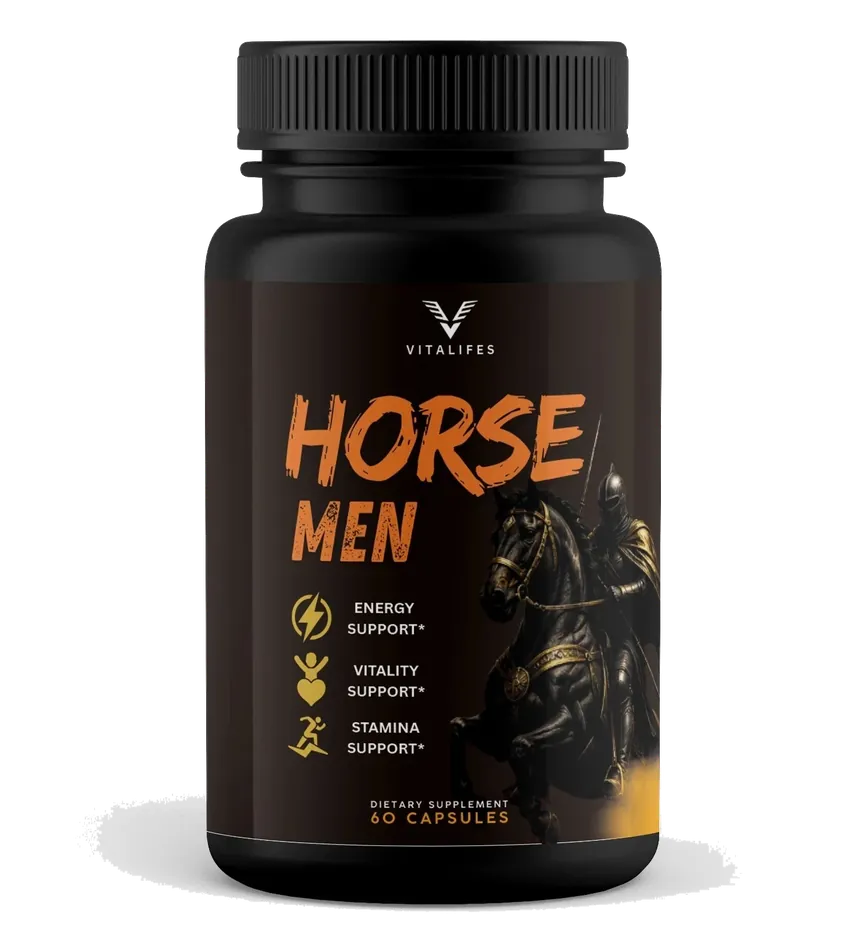
Horsemen Ingredients: What's Really Inside the Blend
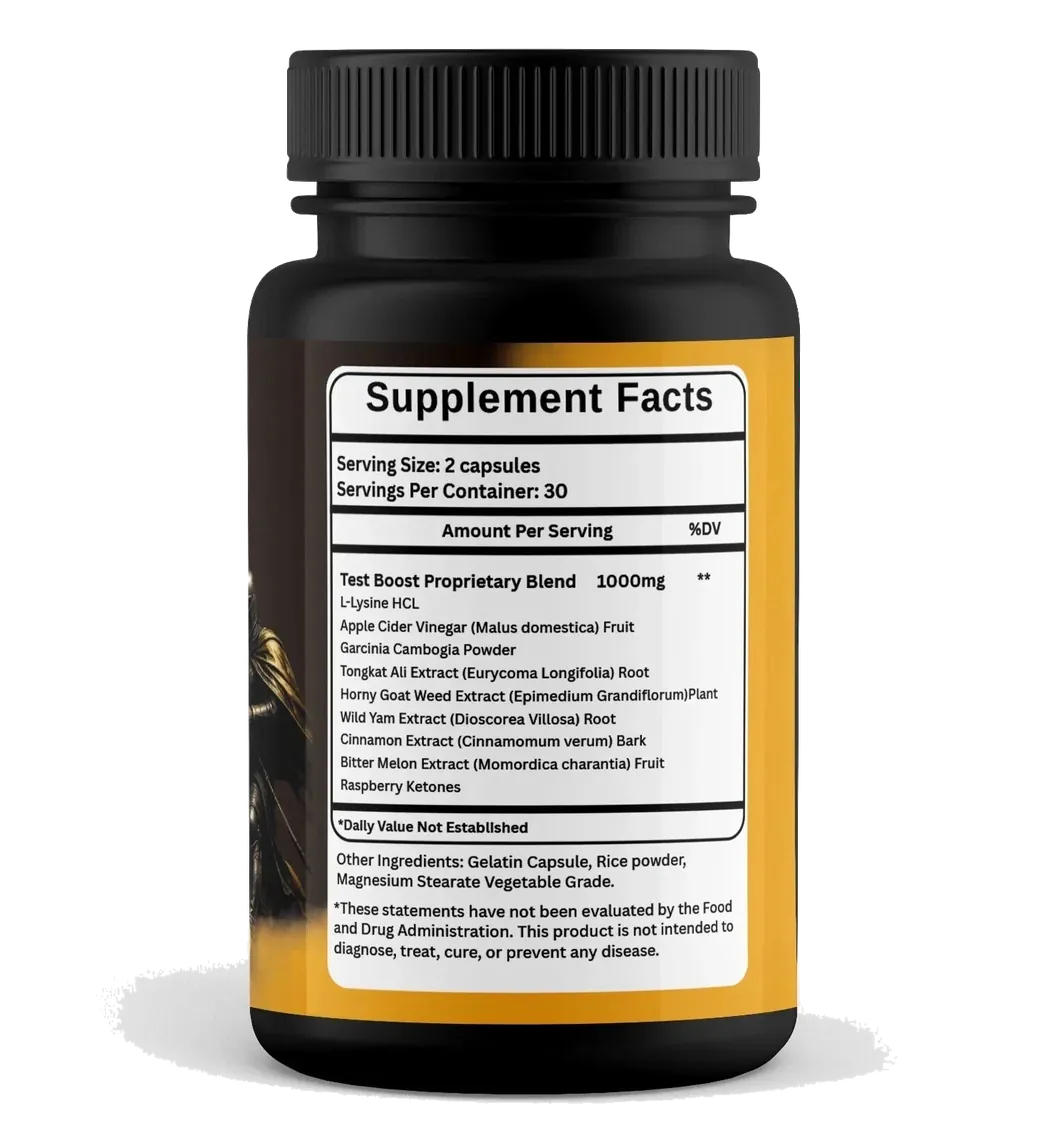
Horsemen packs 9 ingredients into one 1,000 mg Test Boost Proprietary Blend, taken as 2 capsules a day from a 60-capsule, 30-day bottle. The label lists L-Lysine HCL, apple cider vinegar, garcinia cambogia, tongkat ali, horny goat weed, wild yam, cinnamon, bitter melon, and raspberry ketones, but it does not say how many milligrams of each one sit inside that shared blend.
What's Inside Each Horsemen Capsule?
Every capsule comes from one shared blend of 9 ingredients, not 9 separate doses.
Turn a Horsemen bottle around and you see one panel called the "Test Boost Proprietary Blend," followed by 9 ingredient names in a fixed order. That order is the label's own list, and it does not change from bottle to bottle. What does change from ingredient to ingredient is how much science backs it up.
Below, we go through each ingredient in the order it prints on the label, cite the human research where it exists, and say plainly where the evidence is thin. We also show the one number the label does give you: 1,000 mg total for all 9 ingredients combined, in a 2-capsule serving. For the full label text, see the supplement facts page.
One blend, nine names, one total weight
This is called a proprietary blend. That is a legal label format. The maker only has to state the combined weight of the group, not each ingredient's share. We explain the tradeoffs of that format on our proprietary blends guide.
Below the blend, the label lists three other ingredients used to make the capsule itself, not to act on the body: gelatin capsule, rice powder, and magnesium stearate, vegetable grade.
- L-Lysine HCLnot published
- Apple Cider Vinegarnot published
- Garcinia Cambogianot published
- Tongkat Alinot published
- Horny Goat Weednot published
- Wild Yamnot published
- Cinnamonnot published
- Bitter Melonnot published
- Raspberry Ketonesnot published
Equal bars are a placeholder, not a claim. The label lists 9 ingredients in one 1,000 mg total and does not say how much of each is inside.
L-Lysine HCL and Apple Cider Vinegar: What Does the Research Show?
L-Lysine HCL is an essential amino acid. The body cannot make it, so it has to come from food or a supplement. Most human research on lysine looks at cold sores, not energy or stamina. A placebo-controlled crossover trial using 1,000 mg a day found lysine did not lower how often cold sores came back, though patients had slightly more symptom-free stretches (Milman et al., 1980). A later review of that same body of research found doses under 1 g a day were not enough to show a clear benefit, and only a small, lower-quality trial at 3 g a day and above showed a stronger signal (Mailoo et al., 2017).
Apple Cider Vinegar (Malus domestica) is dried vinegar made from fermented apples. Its active part is acetic acid. A 12-week randomized trial using 15 to 30 mL a day (about 750 to 1,500 mg of acetic acid) found real drops in body weight, waist size, and triglycerides compared with placebo (Kondo et al., 2009). A 2025 meta-analysis of controlled trials in people with type 2 diabetes found vinegar lowered fasting blood sugar and HbA1c, with bigger effects at higher doses (Arjmandfard et al., 2025). Both research areas are about blood sugar and weight, not men's energy.
Garcinia Cambogia and Raspberry Ketones: The Weight-Support Ingredients
Garcinia Cambogia Powder is a tropical fruit rind that carries hydroxycitric acid, or HCA. It is one of the most studied weight-loss botanicals. A meta-analysis of randomized trials found Garcinia produced only a small short-term weight loss, about 0.9 kg more than placebo, of unclear real-world value, and more stomach side effects than placebo (Onakpoya et al., 2011). The bigger concern is safety: the National Center for Complementary and Integrative Health notes that several, sometimes severe, cases of liver injury have been linked to garcinia supplements (National Center for Complementary and Integrative Health (NCCIH), 2024).
Raspberry Ketones give raspberries their smell. No human trial of raspberry ketone alone has been published. An animal study found it slowed weight gain in mice fed a high-fat diet (Morimoto et al., 2005), but that finding has never been confirmed in people. Like garcinia, this is a weight-support ingredient borrowed into a men's energy formula, not one built or tested for energy.
Tongkat Ali: The Ingredient With the Most Human Research
Tongkat Ali Extract (Eurycoma longifolia) is a Southeast Asian root, and it carries the most human evidence of any ingredient in this blend. A 2022 meta-analysis of clinical trials found it raises serum testosterone, especially in men who started with low levels, across doses of roughly 100 to 600 mg a day (Leisegang et al., 2022). A 2-week randomized trial in healthy young men found 600 mg a day raised testosterone and free testosterone in a dose-related way (Chan et al., 2021). A separate 6-month trial paired 200 mg a day with exercise and saw improved erectile function and higher testosterone in about half the men (Leitão et al., 2021). We cover the dose research in more depth in our tongkat ali dose guide.
The blend's own name, "Test Boost," points at this ingredient. To be clear: the Horsemen label makes no testosterone-boost promise, and we do not make one either. The label claims are Energy Support, Vitality Support, and Stamina Support, nothing more specific.
Horny Goat Weed and Wild Yam: The Traditional Men's Herbs
Horny Goat Weed Extract (Epimedium grandiflorum) is a traditional herb. Its main active compound, icariin, has been tested in people, but only for safety, not for whether it works. A human trial found icariin was well tolerated up to 840 mg a day, caused stomach side effects at 1,680 mg a day, and absorbed poorly from the gut (Brown et al., 2019). The only sign that icariin might help sexual function comes from a rat study of nerve-injured animals, not people (Shindel et al., 2010).
Wild Yam Extract (Dioscorea villosa) is a root that contains diosgenin, a plant compound. The one controlled human trial we found tested a topical cream, not a capsule, and found no effect on hormone levels compared with placebo (Komesaroff et al., 2001). Diosgenin is not converted into a hormone inside the human body, which is one reason wild yam's traditional reputation has not held up in trials.
Cinnamon and Bitter Melon: The Blood-Sugar Ingredients
Cinnamon Extract (Cinnamomum verum) is true, or Ceylon, cinnamon, the low-coumarin type. Most cinnamon research uses cassia cinnamon instead. A meta-analysis of that cassia research found a modest but real drop in fasting blood sugar (Akilen et al., 2012), a finding that may not carry over fully to the verum type used here. The upside of verum is safety: it is naturally low in coumarin, the compound linked to liver strain in the cassia research.
Bitter Melon Extract (Momordica charantia) is a bitter gourd long used for blood sugar. A randomized trial found 2,000 mg a day lowered blood sugar, though less than the diabetes drug metformin at 1,000 mg a day (Fuangchan et al., 2011). Reviewers rate the underlying evidence as low quality. Bitter melon and cinnamon both belong to blood-sugar research, not men's energy research, and both can interact with diabetes medication. See our side effects page for that caution in full.
How Do Horsemen's Amounts Compare to Research Doses?
The label states a 1,000 mg total. It does not state each ingredient's share of that total.
| Ingredient | Dose used in research | Evidence strength | Amount in Horsemen |
|---|---|---|---|
| L-Lysine HCL | 1000 mg/day tested in the main RCT; a review suggests doses above 3000 mg/day may work better | Weak | not published |
| Apple Cider Vinegar | 15-30 mL/day (about 750-1500 mg acetic acid) | Moderate | not published |
| Garcinia Cambogia Powder | roughly 900-2800 mg/day hydroxycitric acid (HCA) in pooled RCTs | Weak | not published |
| Tongkat Ali Extract | 200-600 mg/day standardized root extract | Moderate | not published |
| Horny Goat Weed Extract | no established human efficacy dose; icariin (its main active compound) was tested up to 1680 mg/day for safety only | Weak | not published |
| Wild Yam Extract | not established; the one controlled human trial used a topical cream, not an oral dose | Weak | not published |
| Cinnamon Extract | roughly 1-6 g/day in most human RCTs (predominantly Cassia cinnamon, not the Cinnamomum verum used in this product) | Moderate | not published |
| Bitter Melon Extract | roughly 500-2000 mg/day dried fruit or extract in most trials | Moderate | not published |
| Raspberry Ketones | no human trials exist; only animal studies (rodent dietary doses) | Weak | not published |
With 9 ingredients sharing one 1,000 mg serving, most cannot sit anywhere near the doses used in the trials above. A serving of 1,000 mg split 9 ways is 111 mg on average. Tongkat ali's lower research dose starts at 200 mg on its own, and bitter melon's trials used 500 to 2,000 mg on its own. Both would need most or all of the blend's weight just to reach that floor, leaving little room for the other 8 ingredients.
What Does the Label Tell You, and What Does It Leave Out?
US supplement rules let a maker list a blend's total weight without breaking out each ingredient, as long as the ingredients are named in descending order by weight. Horsemen follows that format. It is legal, and it is common in this category, but it also means shoppers cannot check any single ingredient against a research dose.
- The blend's total weight: 1,000 mg per 2-capsule serving.
- The 9 ingredient names, in label order.
- The other ingredients used to build the capsule: gelatin, rice powder, magnesium stearate.
- How many milligrams of tongkat ali, or any other single ingredient, are inside.
- Any extract ratio or standardization, such as a percent of active compound.
- Why the ingredients are listed in this order, beyond the standard descending-weight rule.
We list every fact the label withholds on our supplement facts page, and explain what it means for daily use on our how to take Horsemen page.
Ingredients: common questions
Does Horsemen contain a stimulant or caffeine?
No. None of the 9 ingredients on the label is a stimulant, and caffeine is not listed anywhere on the Supplement Facts panel or the Other Ingredients line.
Is Horsemen a testosterone booster?
The blend is named "Test Boost," but the label itself makes no testosterone claim. Its printed claims are Energy Support, Vitality Support, and Stamina Support. Tongkat ali, one of the 9 ingredients, has research showing testosterone changes at 100 to 600 mg a day, but Horsemen does not state how much tongkat ali is inside.
How much tongkat ali is in each Horsemen capsule?
Not published. Tongkat ali is one of 9 ingredients sharing a single 1,000 mg blend, and the label does not break out any individual amount.
Is Horsemen vegan or vegetarian?
No. The capsule shell is listed as gelatin, which comes from animal collagen, not a plant source.
Why does the ingredient list include weight-loss ingredients like garcinia and raspberry ketones?
Garcinia cambogia, raspberry ketones, apple cider vinegar, bitter melon, and cinnamon are usually sold on their own for weight or blood sugar support. In Horsemen, they sit inside a men's energy blend alongside tongkat ali and horny goat weed, which are more commonly used for men's vitality.
Are any of the 9 ingredients considered risky?
Garcinia cambogia and bitter melon carry the most documented safety flags: rare liver injury reports for garcinia, and low-blood-sugar risk for bitter melon in people who also take diabetes medication. Full detail is on our side effects page.
Does Horsemen publish a certificate of analysis for its ingredients?
Not on the public website. A lot number and CoA reference print on the bottle, but the underlying lab report is not posted for shoppers to read before they buy.
What are the non-active ingredients in Horsemen?
The Other Ingredients line lists gelatin capsule, rice powder, and magnesium stearate, vegetable grade. These build and stabilize the capsule; they are not part of the 1,000 mg blend.
Keep reading
Horsemen Supplement Facts: the label, word for word
See the exact panel text, the 1-vs-2 capsule serving math, and both label images in full.
Read →How Does Horsemen Work?
What the research suggests for each ingredient, and what stays unknown without published amounts.
Read →Horsemen side effects: what to know before you take it
The safety notes tied to garcinia, bitter melon, cinnamon, and tongkat ali, explained plainly.
Read →Order Horsemen from the authorized retailer
60 capsules per bottle, a 30-day supply at the label serving. Pack prices show on the secure listing before you pay, and every pack carries the same money-back guarantee. Questions first? Call +1 (302) 200-3480.